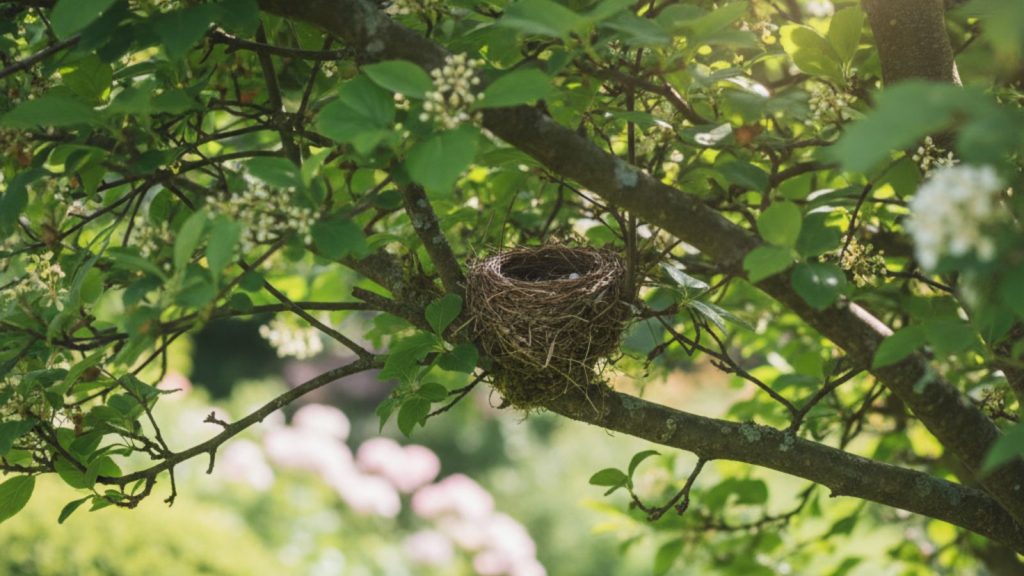
Spring and early summer bring special moments to gardens. Days get longer, birds fill the air with song, and many favourite garden birds start nesting. Here we explore how to tell if birds are nesting in your garden.
If you see more activity around hedges, trees, sheds, or bird boxes, you might already have birds nesting nearby.
1. Repeated Visits to the Same Spot
A clear sign that a bird is nesting is when it keeps returning to the same spot.
You might see:
- A robin flying into thick ivy several times an hour.
- A blue tit repeatedly enters a nest box.
- A blackbird disappearing into a hedge.
Birds that are building nests or feeding chicks often use the same flight paths. If you see this happening for several days, they are likely nesting.
2. Carrying Nesting Materials
During nesting season, which is usually from March to July, birds collect materials like:
- Moss
- Dry grass
- Twigs
- Feathers
- Pet hair
- Mud
If you see a bird with nesting material in its beak, it is busy building a nest close by.
Blue tits and great tits often choose nest boxes, while blackbirds and robins like dense shrubs, hedges, sheds, or even hanging baskets.
3. Birds Acting Defensively
Parent birds get very protective once they have eggs or chicks in the nest.
Signs include:
- Alarm calls when you approach.
- Swooping behaviour.
- Sudden agitation near a particular bush or structure.
Blackbirds, especially, can be very bold when protecting their nests. If birds act extra noisily or seem nervous when you are near a particular part of the garden, there is a good chance a nest is hidden close by, defending it.
4. You Hear Chicks
As chicks get bigger, they get louder. Listen for:
- High-pitched chirping from hedges.
- Constant peeping from nest boxes.
- Increased feeding activity from adults.
Parent birds might come and go every few minutes when feeding is at its busiest. Early mornings are often the most active time.
5. Increased Feeding Activity at Bird Feeders
If you have bird feeders, you might see adult birds grabbing food quickly and flying away instead of eating right there.
This usually means they are taking food back to feed their chicks.
High-protein foods like mealworms are essential during nesting season because chicks need protein to grow well.
Common Garden Birds That Nest in Gardens
Some of the most common nesting birds in gardens include:
- Robin – nests in sheds, ivy, and plant pots.
- Blackbird – builds cup nests in hedges.
- Blue tit – favours nest boxes.
- Great tit – uses boxes and tree holes.
- House sparrow – nests in the roof eaves or dense shrubs.
- Wren – builds domed nests in thick foliage.
If your garden has native shrubs, thick hedges, climbing plants, or bird boxes, you are already giving birds a great place to nest.
What to Do If Birds Are Nesting in Your Garden
If you think there is a nest, leave it undisturbed.
- Keep pets away from the area.
- Do not cut hedges during nesting season.
- Continue providing fresh water.
- Offer appropriate bird food.
It is safest and most responsible to watch birds from a distance.
When Is Bird Nesting Season?
Most garden birds nest from March to July, but some may start earlier if the winter is mild or have more than one brood during the year. The busiest nesting time is usually from April to June.
How to Encourage Nesting Birds in Your Garden
If you want to help nesting birds, you can:
- Install species-appropriate nest boxes.
- Plant native hedging (hawthorn, holly, blackthorn).
- Avoid pesticides.
- Provide clean water year-round.
- Leave some areas slightly wild.
Even a small garden can be a valuable place for birds to nest.
New to Feeding and Supporting Garden Birds
If you are new to attracting and caring for garden birds, it helps to learn the basics first. Take a look at our Start Here page, where you will find tips on choosing the right feeders, selecting the best food and making your garden welcoming all year round.
Final Thoughts
If you notice repeated flights, nesting materials, defensive actions, or hear tiny chirps, there is a good chance birds are nesting in your garden. It is a privilege to have wildlife in your garden. With some care and patience, your garden can become a safe place for many generations of garden birds.